Botswana lies to the north of South Africa, borders Namibia to the west and north, touches on south-western Zambia,and shares a border with Zimbabwein the east. Much of Botswana consists of the Kalahari (or Kgalagadi) Desert; the most fertile country comprises the eastern borderlands. Botswana is the world's leading diamond producer, providing 80 per cent of gem-quality stones.
Main languages: Setswana, English (official) and 26 ‘unrecognised' minority languages
Main religions: traditional religions, Christianity
Main minority groups include Kalanga, Bakgalagadi, (Kgalagari), Basarwa,(N/oakhwe, San and Bushman people), Mbanderu (Herero), Wayeyi (Koba, BaYeyi) and Mbukushu (Mpukushu,)
The last census to give ethnic and linguistic information was during colonial times. The Committee for the Elimination of Racial Discrimination has criticized the Botswana government for failing to provide disaggregated data, and for underestimating minority populations.
The British Protectorate of Bechuanaland, established in 1885, acted as a buffer against further encroachment from South Africa. Colonial rule was indirect and European settlement limited. At independence in 1966 Bechuanaland became Botswana.
The British colonialists cultivated Tswana tribe and their chiefs as the rulers of Botswana. They assumed that ‘no other tribes existed or had chiefs'.[1] The non-Tswana tribes - either in the South or North - were not brought into the governance structures prior to independence. After independence, the Tswana-tribes consolidated their hegemony. By continuing arrangements put in place by the British, they promoted a mono-lingual and mono-cultural state, to such an extent that the multi-cultural, multi-tribal nature of Botswanan society has become virtually unknown to the outside world. Indeed, many international reference books refer to Botswana as a majority Tswana society - a distortion of the facts.[2] The Tswana are a numerical minority in the country. In the years after independence, the teaching of other tribal languages was banned - and only Setswana was taught as a native language. The campaigning organisation Reteng estimates that the remaining 26 languages are highly-endangered.[3] The traditional tribal structures of the non-Tswana communities have been undermined and marginalized.
Despite wide recognition by governments and NGOs for its good governance, Botswana was slow to react to the HIV-AIDS pandemic, and today the UN says that more than one in three adults in Botswana is HIV-positive or has AIDS. The government has since reacted to the catastrophe with aggressive public health policies, and anti-retroviral drugs are now available to most of the population. However, a 2003 report found that the dissemination of effective anti-Aids messages was hampered by the fact that Radio Botswana only broadcast health advice in English and Setswana. Minorities living in remote regions have suffered exceptionally high rates of infection and are hard to reach.
In recent years, Botswana has seen an influx of refugees from neighbouring Zimbabwe as that country's economy has imploded.
A major source of grievance for minority groups has been the legal and constitutional arrangements which have discriminated against them.[4] Most of the laws of Botswana recognise and protect the rights of the eight Tswana speaking groups with regards to ethnic identity (including language and culture), land (which entails the economy and culture) and chieftaincy (which entails governance and decision-making, both regionally and nationally). However no such similar recognition or protection is given to the non-Tswana speaking ethnic groups in Botswana.
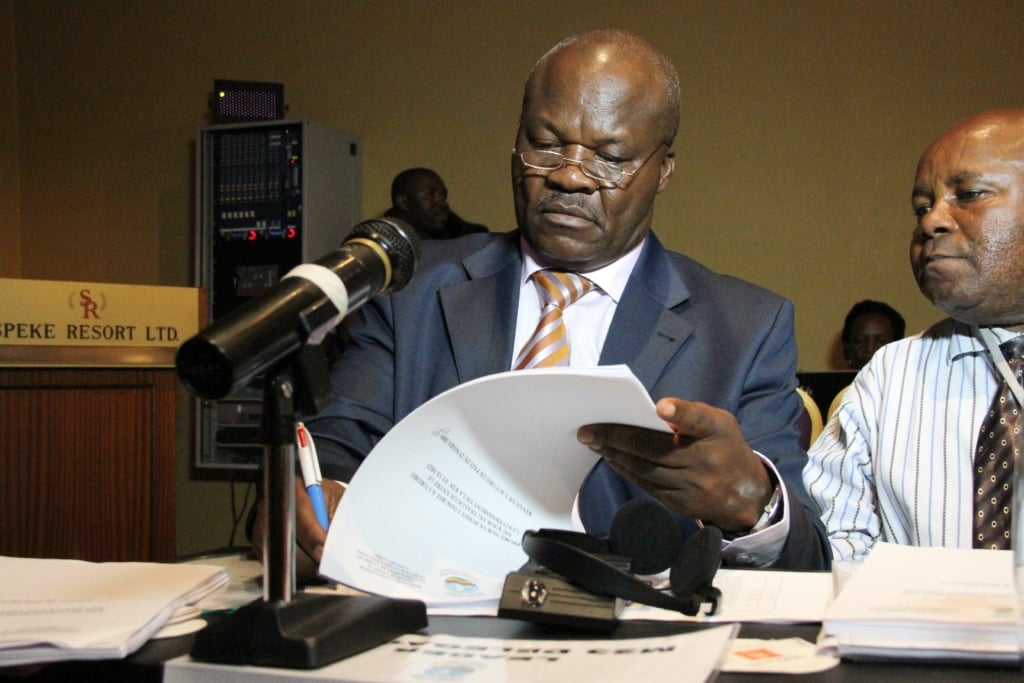
The role of traditional chiefs has become particularly contentious. The House of Chiefs (called the Ntlo ya Dikgosi in Setswana) advises Parliament on any matter of national concern and is particularly consulted by the government on issues that are likely to impact on the culture and tradition of Botswana. Under the Chieftainship Act (1933), only the eight principle Tswana-speaking tribes are admitted to the House of Chiefs. These representatives then go on to nominate sub-chiefs of non-Tswana speaking crown lands. They are often not regarded as the "rightful chiefs" chiefs or the preferred choice of the people.
This system has come, increasingly, under challenge, as Botswana's minorities have begun to organise and campaign for change. In 2001, the High Court of Botswana delivered its judgment in the case of Kamanako and Others vs Attorney-General and Another, brought by the-then head of the Wayeyi tribe, and others. The ground-breaking High Court ruling found that the exclusion of the Wayeyi from the House of Chiefs was discriminatory and unjustified.
In response to the verdict, the government set up the Balopi Commission, and after completion of its inquiries, the government produced a draft white paper. However, minority rights campaigners have petitioned the government, complaining that the new proposals do not diminish discrimination - but in fact, entrench it.
Growing activism by the unrecognised minority tribes in Botswana has led to a higher profile for their issues. Campaigners - supported by MRG - are currently pursuing a case at the Africa Commission on Human and Peoples' Rights and have put forward their grievances to the UN Committee on the Elimination of Racial Discrimination, (CERD) the body which monitors the implementation of the UN treaty aimed at eliminating racial discrimination - a treaty to which Botswana is a signatory. In early 2006, CERD criticized the government for not providing adequate information on the ethnic and linguistic composition of its population. Among other issues, it expressed its concern ‘that the State party's objective to build a nation based on the principle of equality for all has been implemented in a way detrimental to the protection of ethnic and cultural diversity'.
In late 2006, rights activists complained about a speech given by President Festus Mogae, marking forty years of independence. Mogae warned against marginalized communities setting up ethnic cultural groups. The UN News agency, IRIN, reported that Mr Mogae said "We should avoid setting up exclusive organisations whose membership is drawn from one tribe...Our goal of nation-building needs to prevail over narrow tribal sentiment." Reteng - a coalition of ethnic cultural groups - responded by saying that such groups should be acceptable in a democracy. In 2008 the Chieftainship Act was to be replaced by the "Bogosi Bill", but this retained many of the same shortcomings. In March 2008 the UN Human Rights Council criticized the government for its failure to consult all interested parties before taking up the bill. The Council also recommended that the Botswana government ‘ensure that it repeals any discriminatory element in the appointment and representation of tribes in the Ntlo ya Dikgosi, to ensure fair representation of all tribes.' Nearly simultaneous with the release of the Committee's statement, outgoing President Mogae appointed a Wayeyi representative to the House of Chiefs three days before leaving office to his successor, Ian Khama Seretse.
The expulsion of Basarwa/San people from their ancestral land in the Central Kalahari Game Reserve has also remained in the spotlight. In a landmark 2006 case, the Botswana High Court ruled the Basarwa should be allowed to return to the CKGR - however, when a group of Basarwa/San attempted to return in January 2007, they were blocked from entering CKGR, with family members who were not named as plaintiffs. While the Barsawa/San court victory made news headlines around the world, the government of President Festus Mogae appears to intent on taking the narrowest possible interpretation.
[1] The Development of Minority Languages for Adult Literacy in Botswana: Towards Cultural Diversity, by Lydia Nyati-Ramahobo & Andy Chebanne, University of Botswana, accessed via www.reteng.org
[2] See, for example, the CIA directory, at www.cia.gov, which states that Tswana make up 79 per cent of the population.
[3] www.reteng.org
[4] For the full text of MRG's submission to the African Commission on Botswana, go to our website, www.minorityrights.org under International Statements