Environment

The Kyrgyz Republic is a landlocked state in Central Asia bordering Kazakhstan to the north, Uzbekistan to the west, Tajikistan to the south-west and the People’s Republic of China to the south-east. Much of the country’s southern part is made up of the Tian Shan mountainous region, part of the Himalayan Belt.

Peoples

Main languages: Kyrgyz (state language), Russian (official since 2001), Uzbek

Main religions: Sunni Islam, Orthodox Christianity

Minority groups include Uzbeks (14.2%), Russians (10.3%), Dungans (1.1%), Uighurs (1%), as well as groups of Tatars, Kazakhs, Ukrainians, Germans, Tajiks, Koreans, Jews, and North Caucasians (US State Department, 2005).

The ethnic Kyrgyz now make up almost 70 percent of the population. Slavs – mainly Russians but also some Ukrainians – were until recently the largest minority in Kyrgyzstan. Unlike in other Central Asian states, a significant proportion of Slavs are rural dwellers. Their numbers have however decreased rather dramatically in the last 10 years: some estimates put their size now to less than 9%, with the Uzbeks, who constitute perhaps as much as 15% today, appearing to be the country’s largest minority. They are concentrated mainly in the Fergana valley in the west of the country. The vast majority of Germans have also emigrated, mainly to Germany. Jews, once numerous in the capital and respected for their contribution to health care, engineering and culture, are another rapidly disappearing group. The vast majority have emigrated to Israel, others to the USA and Germany.

History

What is today Kyrgyzstan lied on the path of the Silk Road. It therefore was a route followed by population groups as well as invaders, which explains partially its population makeup. For much of its history after the 13th century the territory of Kyrgyzstan was under the sway of Mongol khanates after Kyrgyz tribes were conquered by the son of Genghis Khan, Juche.

They subsequently regained their freedom in the 16th century, only to be overrun in the next century by the Kalmyks, by the Manchus in the 18th century, and the Uzbeks in the 19th. It was then to be absorbed by Russia in 1876 – and then the Soviet Union – until it declared independence in August 1991. The last two periods of occupation – by the Russians and Uzbeks – and the geographic proximity of Russia and Uzbekistan help understand the presence of these large population groups in Kyrgyzstan.

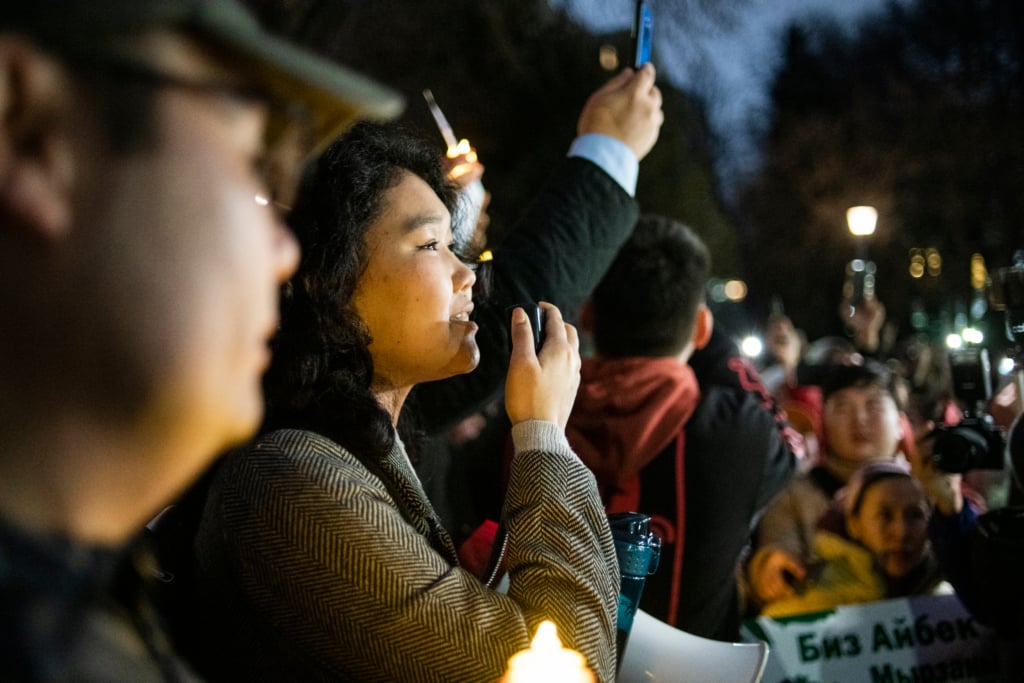
Tensions between the majority Kyrgyz and minorities erupted into violence even before independence, when violence broke out in the city of Osh, in the Ferghana valley, where minority Uzbeks and Kyrgyz clashed in 1990. These tensions were to remain until the present time as the Kyrgyz sought to establish their pre-eminence in the new state, increasingly replacing the Russians and asserting their dominance by making Kyrgyz the main language of government.

While Kyrgyzstan’s first president, Askar Akayev, was seen as a moderate leader in his first term of office, criticisms emerged in the latter part of the 1990s as he began to show increasing autocratic tendencies and began cracking down on some of the opposing voices.

The increasing prominence of the Kyrgyz language, though Russian remained as a ‘language of inter-ethnic communication’ signaled on the one hand that the Russian-speaking minority were facing growing obstacles in terms of access to employment in the civil service. At the same time, there was no recognition for the use of the language of the Uzbek which would eventually surpass in size that the Russian minority. Tensions thus remain high in the Ferghana valley where Uzbeks are concentrated, with recent demonstrations by Uzbeks against the lack of status of their language and limiting their economic and employment opportunities.

As for the Russian minority, the diminishing prestige of their language coupled with limited employment opportunities and a sense that Kyrgyzstan was to be – increasingly – the country of the Kyrgyz led many of them and other Slavs to emigrate: perhaps half of the approximately 916,000 members of the Russian minority left the country between 1991 and 2005.

Parliamentary and presidential elections in the 1990s were seen as flawed, while those in 2000 were deemed by the Organization for Security and Cooperation in Europe (OSCE) not to have been free and fair. Pressure from the government on independent media and opposition politicians increased. Further elections in 2005 were again – despite some improvements – deemed not to have been free and fair by outside observers. Shortly after large demonstrations on 24 March 2005 led to President Akayev fleeing the country and eventually resigning on 4 April 2005 in what is sometimes known as the Tulip Revolution.

Acting President Kurmanbek Bakiyev won the presidential elections of 10 July 2005 with 88.9% of the vote. His popularity however declined amid accusations that his administration has been unable to tackle either Kyrgyzstan’s problems of corruption, and concerns over the assassination of a number of parliamentarians. There were large opposition demonstrations in 2006 and in April 2007 in Bishkek accusing the president of not fulfilling his electoral promises to transfer some powers to Parliament.

Governance

Official policies in Kyrgyzstan have often been described as more ‘minority friendly’ than some of its neighbours. There are a variety of mechanisms in place for consultations of minority groups, and state support is available for various minority organisations or efforts. By granting the Russian language a special status as a ‘link language’ under the Constitution, authorities seemed to have hoped to demonstrate their desire to be inclusive and encourage Russians and other Slavs to remain in the country.

Problematically, the treatment of the Uzbek minority seems somewhat unbalanced when compared to the Russian minority, in that while both groups are close to the same size, only Russian has some sort of official status which benefits Russian-speakers in terms of employment and educational access. There is no status whatsoever in relation of the Uzbek language despite the large number of speakers. Recent legislation has increasingly reduced opportunities for non-Kyrgyz-speakers – and in particular members of the Uzbek minority in the south of the country where they are concentrated – such as 2004 legislation requiring that certain candidates and public services officials must be proficient in Kyrgyz. Though the law is ‘pending’ until 2015, it has caused considerable consternation and led to calls for it to be dropped altogether.

Emigration also presents a serious challenge for Kyrgyzstan. It causes a drain of skilled workers, adversely affects the economy and impairs the establishment of stable public institutions which need non-Kyrgyz staff. It can also result in the remaining members of minorities becoming more vulnerable to xenophobia.

The recent change in regime in 2005 and the approval of a new constitution in 9 November 2006 makes it uncertain as to how these events will affect minorities, though it should be noted that many of President Bakiyev’s supporters are from the south where the Uzbek minority is concentrated.

Current state of minorities and indigenous peoples

The situation for minorities in Kyrgyzstan has not improved significantly in recent years. The country has experienced the departure of large numbers from minority groups, though perhaps to a lesser extent than many of its neighbours. It was until recently the only country in the region to have retained Russian as an ‘official’ language (i.e. ‘language of inter-ethnic communication’).

The growing trend towards a ‘Kyrgyzstan for the Kyrgyz’ has picked up steam in the last few years, however, through language legislation passed by the lower house of parliament in 2004. This legislation seems to pave the way to further disadvantaging minorities such as the Uzbek-speaking minority (about 15 per cent of the population) and Russian-speaking minority (perhaps 11 per cent), especially since the new language provisions require that candidates for elected office need to demonstrate proficiency in Kyrgyz, as do students wishing to enter or graduate from university. State officials are to use primarily Kyrgyz, though Russian remains as a ‘language of inter-ethnic communication’.

The Uzbek minority, based in the restive southern parts of the country, in particular may experience this as a way of assuring the dominance of the Kyrgyz majority. The former’s almost complete exclusion from administrative and political positions, despite their now constituting the largest minority in the country, has probably contributed to the strength of fundamentalist beliefs (often officially described as Wahhabist interpretations) among some Uzbeks, and to government crackdowns and suspicion against members of this minority, or rather by resentment on behalf of the majority group. It is still unclear what the long-term effects of the revolution in 2005, which saw then President Askar Akayev deposed, will mean in terms of the treatment of minorities in Kyrgyzstan. One notable effect of recent events is the upsurge in the number of applications for emigration to Russia since the overthrow of Akayev in 2005, most of who are presumably ethnic Russians.

In the short term, the effects at least for the Uzbek minority are not positive, with calls for the addition of Uzbek as an official language and demonstrations in support of this have been met by violence and even murders of proponents in Osh and southern provinces.

Demonstrations calling for an official status for the language and for some kind of proportional representation of Uzbeks in state administration in the southern provinces occurred in 2006, and property owned by prominent Uzbek was seized in 2007.

In its August 2007 Report, CERD expressed concern for ethnic Uyghurs and Uzbeks, who, the Committee alleges, were forcibly returned to their countries of origin after seeking refugee status or asylum in Kyrgyzstan. Regarding the clashes that had taken place in February 2006 between Kyrgyz and Dungan communities living in Iskra, CERD recommended that the government brought those responsible to justice, provide compensation to the families that had been forced to leave, and that measures be adopted to promote dialogue and understanding between the two communities.

Post a comment
In order to post a comment, please log in:

E-mail:

Password:

No account? - Please register